At a glance
Spend your first day in Oxford around Broad Street, the Bodleian Libraries and Radcliffe Square, then walk through Christ Church Meadow. Keep the second morning for the Ashmolean and the afternoon for Jericho or University Parks. Book the particular library tour you want: access to the Radcliffe Camera is not included in every Bodleian visit.
How should you divide two days in Oxford?
Oxford rewards a little selectiveness. Its best-known buildings stand close together, but a university library tour, a college visit and a museum each deserve more time than their positions on a map suggest. This itinerary groups the university centre and meadow on the first day, with art and a neighbourhood walk on the second. The table gives suggested time allowances, including pauses; these are planning estimates rather than opening hours or guaranteed visit lengths.
Make one reservation the anchor of your first day. If seeing inside a historic library is your priority, use your Bodleian tour time to organise the streets around it. If Christ Church is the main reason for the trip, arrange that visit first and shorten the library portion. You can enjoy Oxford without booking both. Public streets, the meadow and the Ashmolean's general collections make a substantial visit in their own right.
| When | Area | Allow |
|---|---|---|
| Day 1 morning | Broad Street, Radcliffe Square and booked library tour | 3–4 hours |
| Day 1 afternoon | Covered Market and Christ Church Meadow or college | 3 hours |
| Day 2 morning | Ashmolean collections | 2–3 hours |
| Day 2 afternoon | Jericho or University Parks | 2 hours |
A street-by-street first-day route
A useful walking sequence is Broad Street, Catte Street, Radcliffe Square, High Street and the Covered Market, followed by St Aldate’s and the public meadow entrance by the War Memorial Garden. Allow roughly 25–40 minutes for the connecting walks, before adding the library tour, lunch and meadow time. This is our planning estimate for an unhurried walker, not a measured tour duration. It keeps the morning’s university buildings together, then moves south after lunch. On day two, the Ashmolean on Beaumont Street pairs naturally with a walk towards Walton Street and Jericho. Choose University Parks instead if green space matters more than browsing; avoid zigzagging between both afternoon options.
Day one morning: Broad Street and the library quarter
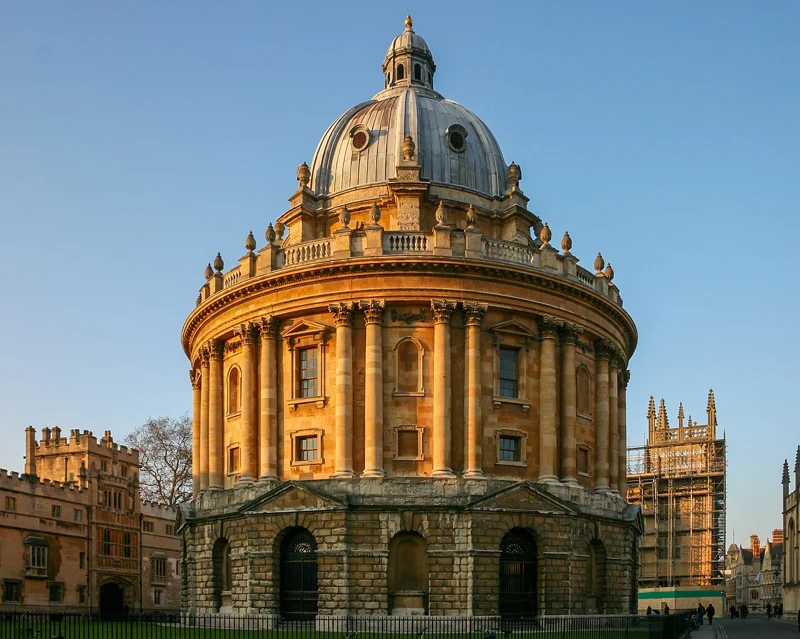
Begin on Broad Street, where the university buildings are easier to understand as a group. From the street you can see the Sheldonian Theatre and approach the Bodleian precinct. Walk towards Radcliffe Square before turning every doorway into a ticket decision. The circular Radcliffe Camera gives the square its focus, while the surrounding colleges and library entrances show how much of central Oxford remains a working academic place.
The distinction between outside access and a library tour matters here. The Old Library and Radcliffe Camera are working libraries, and visitors enter through designated guided tours. The Bodleian offers several products with different rooms and durations. Read the actual itinerary before buying: a standard library tour should not be assumed to include the Camera. The Weston Library's ground floor offers a free alternative for visitors who want a more flexible stop.
For a first visit, allow a generous morning around this area, including the booked tour, an exterior circuit and a coffee break. Tour check-in and walking between entrances take time even when the buildings look adjacent. Families should check the selected tour's minimum age, and anyone needing step-free access should consult that tour's access details. A photograph of a grand doorway tells you very little about the stairs behind it.
Lunch: use the Covered Market as a useful route break
Walk towards the Covered Market for lunch or a browse among its businesses. Its position between the university quarter and the streets leading south makes it a practical break in the day. Look at what is being prepared, compare a couple of menus and decide whether you want a meal at a table or something smaller. Leave enough room in the schedule to sit down; Oxford can involve considerably more standing than the map implies.
Keep your first afternoon geographically compact. If you have already spent the morning inside the Bodleian, adding several paid college interiors immediately afterwards can blur them together. A market lunch followed by the meadow gives the day a change of pace. On a wet afternoon, you could instead bring forward part of the Ashmolean visit and leave the meadow for a clearer spell on day two.
Day one afternoon: Christ Church and the meadow
Approach Christ Church with two separate possibilities in mind. Visiting the college is an admission-based experience with its own route and arrangements. Christ Church Meadow is a distinct public walking space, accessible during daylight under the college's published visitor guidance. Walking in the meadow does not grant admission to the college buildings, and buying a college ticket should not be your automatic response if all you want is the outdoor walk.
Choose a meadow route that fits the remaining daylight and your energy. A short walk away from the street already changes the feel of the afternoon; there is no need to turn it into a long riverside expedition. Paths can be affected by weather, so use the signed public access points and adapt the distance if surfaces are wet. For a quieter experience, allow time to stop and look back towards the college buildings instead of treating the green space as a passage between sights.
If you do book a college visit, keep the meal before it relaxed and arrive at the specified entrance. Academic buildings may have event-related access arrangements, and the route shown on your booking is more useful than an old photograph or a general city map. After the visit, decide whether a short meadow circuit is enough. Finishing here also leaves your evening free for dinner close to your accommodation.
Day two morning: give the Ashmolean a clear focus
The Ashmolean is the strongest reason to reserve a second morning in Oxford. General admission to its collections is free, while special exhibitions may require their own ticket. Before entering, choose a subject or a few galleries that interest you. A focused visit gives you room to look closely at individual objects and their labels without feeling that you have failed to cover the building.
Allow roughly two to three hours as a starting point, then adjust to your interest. If you prefer painting, begin there; if archaeology draws you in, build the morning around those displays. Check the museum's current gallery information rather than assuming every object pictured online is on view. Break midway if needed, especially if yesterday included a long library tour. This is a useful indoor anchor when Oxford's weather makes a long outdoor morning less appealing.
Travellers choosing their trip around collections can compare Oxford with our art and museum city breaks. The useful comparison is the kind of visit you want: one major institution with time to linger, or several smaller places spread across the day. Oxford works particularly well when the Ashmolean is allowed to be the main event rather than an hour squeezed before a train.
Day two afternoon: Jericho or University Parks
After lunch, choose between a neighbourhood afternoon in Jericho and a green-space walk in University Parks. Jericho suits visitors who want cafés, independent businesses and a less monument-heavy part of the city. Give yourself permission to browse and stop somewhere that appeals to you. It makes a natural contrast with the formal university spaces from day one, without requiring another substantial admission ticket.
University Parks is the better choice if you want open space before travelling home. Match your route to the weather and the time you need to return for luggage. You can enjoy a short walk without committing to a full circuit. If you are travelling with children, this flexible afternoon also avoids promising another interior visit when everyone has already spent the morning concentrating in a museum.
Save a final university-quarter pass for the end only if you have time. Returning to Radcliffe Square after your library tour can make the buildings more meaningful, but it should not jeopardise your departure. For a comparison with another university city, our two-day Cambridge guide puts college access and the river at the centre of the plan. Visit them on separate stops if you want to appreciate their differences.
Arriving, choosing a base and travelling without a car
Oxford suits a car-free city break because the core of this route is compact. When comparing rail journeys, check the station carefully: Oxford and Oxford Parkway are different arrival points. Build the onward journey into your accommodation choice, particularly if you are carrying luggage. From any station or coach stop, use the actual walking route to your lodging rather than judging proximity from a straight-line distance.
Staying near the centre makes it easier to return between the meadow and dinner. A base towards Jericho may suit a trip built around the Ashmolean and quieter evening streets. Check room access as well as neighbourhood location; an upper-floor room in an older building may involve stairs. If driving is necessary, decide on parking before arrival and leave the car out of the sightseeing route.
Oxford can form part of a longer trip with London over three days or a two-day visit to Bath. Treat each transfer as travel time when planning the sequence. A day described as two hours in a museum, a college tour and an intercity journey can become tiring once luggage storage and meals are included. Two nights in Oxford offer much more flexibility than arriving late and leaving after lunch.
What to book, and what to leave flexible
Prioritise a specific Bodleian tour, a chosen Christ Church visit and any Ashmolean exhibition you particularly want to see. Check the official product pages for inclusions, entry points and access arrangements. Outdoor walks, the free museum collections and neighbourhood time can remain flexible around those bookings. This division helps you rearrange the day if it rains without turning every change into a lost ticket.
For a modest-budget version, keep the library exteriors, use the Weston ground floor, walk in the meadow and spend the second morning at the Ashmolean. Choose one paid experience because it interests you, not because every landmark needs an interior visit. Before travelling, recheck opening information for your dates; the route is designed to last, while individual visitor arrangements can change.
Frequently asked questions
Is two days enough for Oxford?
Two full days are enough for the university quarter, one booked library or college visit, Christ Church Meadow and a substantial Ashmolean visit. Add another day if you want several college interiors or more museum time.
Can you visit the Radcliffe Camera without a tour?
General visitors need an appropriate guided tour to enter the Radcliffe Camera. Check the tour description carefully, because other Bodleian tours visit different spaces. You can see the building from Radcliffe Square without booking.
What can you do in Oxford for free?
Options include the university streets and squares, the Weston Library ground floor, Christ Church Meadow during permitted daylight access, University Parks and the Ashmolean general collections. Exhibitions and college interiors may have separate charges.
Should you visit Oxford or Cambridge?
Choose Oxford if the Bodleian and Ashmolean are priorities. Cambridge suits a visit built around the Cam, college views and the Fitzwilliam Museum. Both deserve time beyond a brief photo stop; our two-day routes explain the practical differences.
Sources and checks
- Bodleian Libraries: tour FAQsChecked: 23 October 2026
- Christ Church: meadowChecked: 23 October 2026
- Ashmolean: ticketsChecked: 23 October 2026
- Experience Oxfordshire: Oxford itineraryChecked: 23 October 2026
Itineraries are editorial suggestions for independent visits. Check current prices, opening hours and trail conditions with official providers.