At a glance
Spend your first day in Lucca walking a section of the city walls, exploring Piazza dell’Anfiteatro and choosing whether to climb Guinigi Tower. Use day two for San Martino Cathedral and the Puccini Birth Home. The full wall circuit is about 4.2 kilometres; it works as a relaxed outing of its own rather than a shortcut between every sight.
Why stay in Lucca for two days?
Lucca is easy to underestimate because its historic centre sits within such a clear boundary. The walls make it look as if everything can be covered in one continuous lap. In practice, the best visit alternates between the elevated promenade and the streets, with time for a tower, a church or a small museum according to your interests. Two days let you make those choices without rushing back to another city after lunch.
Use the first day to understand the shape of the centre and the second for music and religious art. The table below gives suggested time blocks, with pauses included. You can reverse the order to suit museum opening days or a tower reservation. Keep at least one part of the visit open for simply returning to a square, taking a second wall walk or sitting over a meal.
| When | Plan | Allow |
|---|---|---|
| Day 1 morning | Wall walk and Piazza dell’Anfiteatro | 3 hours |
| Day 1 afternoon | Optional Guinigi Tower and central streets | 2–3 hours |
| Day 2 morning | San Martino Cathedral and selected complex spaces | 1.5–2 hours |
| Day 2 afternoon | Puccini Birth Home, lunch and a final wall section | 3 hours |
Connect the squares without repeating the whole circuit
From the southern entrance around Porta San Pietro, the San Martino area is a useful first orientation point. For the northern part of the centre, use Via Fillungo to reach the San Frediano and Piazza dell’Anfiteatro area, then return through the streets towards Guinigi Tower on Via Sant’Andrea. Allow about 30–45 minutes for an unhurried connection across these central areas, before a tower climb or church visit. On day two, combine San Martino with the Puccini Birth Home and Piazza San Michele area. The wall promenade can be added at whichever public access point suits your route; you do not need to repeat the entire 4.2-kilometre circuit to reach each quarter.
Day one morning: begin with the city walls
Lucca's walls form a circuit of about 4.2 kilometres around the historic centre. Their broad upper promenade is a different experience from the narrow wall-top paths found in some other cities. Built as defences between the sixteenth and seventeenth centuries, they now provide a tree-lined public route with views both into the centre and towards the surrounding city. A walk here gives you an immediate sense of Lucca's size and layout.
You can complete the circuit or choose a shorter section. For a first morning, allow roughly an hour and a half if you want frequent pauses, adjusting to your walking pace. The full length is not compulsory. Enter and leave by suitable public ramps or stairs, and check the access point if you need a step-free route. Being able to walk on the walls does not mean every approach is equally convenient.
The route is shared with other users, including cyclists, so keep aware when stopping for photographs or moving across the path. Follow signs and avoid climbing onto the grassy edges of the fortifications. If you hire a bicycle, choose a manageable pace and remember that pedestrians may step aside unpredictably. For a short city break, walking is often the simplest way to stop and look at the rooftops and towers below.
Piazza dell’Anfiteatro: understand the shape before sitting down
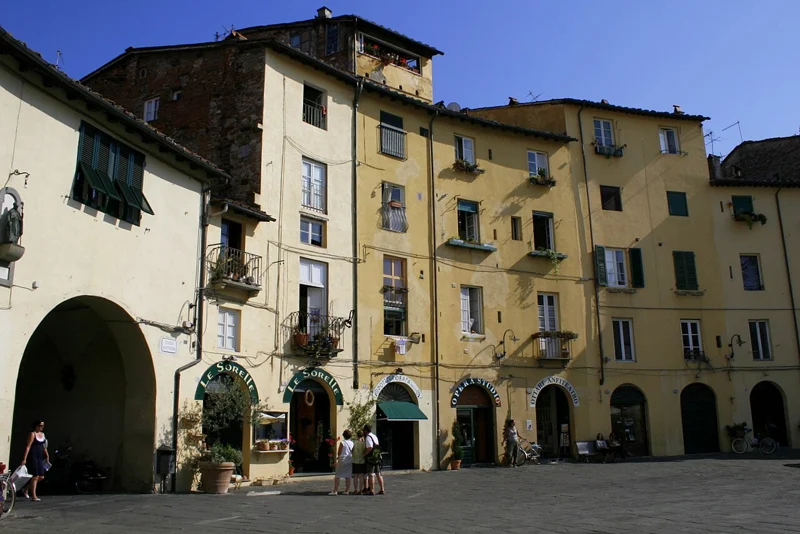
Leave the wall route for the streets leading towards Piazza dell'Anfiteatro. The enclosed oval space preserves the shape of the Roman amphitheatre that once occupied the site. The current square is the result of later building and nineteenth-century remodelling, rather than an intact Roman arena. Knowing that helps you read the curve of the surrounding houses and the passages leading into the square.
Enter through one of the public passages, walk around the space and notice how the view changes near the edges. It is a pleasant place for a pause, but compare menus and decide whether you want a coffee or a full lunch before taking a table. You can appreciate the architecture without making the square the only place where you eat. Leave room in the itinerary for the streets immediately outside it as well.
Nearby San Frediano is another possible stop, especially if its decorated façade interests you. Check the current visitor arrangements if you want to enter. A short exterior look followed by a longer visit elsewhere may suit the day better than several consecutive church admissions. Visitors who enjoy compact Italian centres can compare Bologna’s two-day itinerary, where porticoes give walking routes a very different character.
Guinigi Tower: a worthwhile climb if it suits you
Guinigi Tower is one of Lucca's most recognisable landmarks because of the holm oaks growing at its top. The tower is about 45 metres high and has no lift. Choose the ascent only if you are comfortable with the staircase and the visitor route. A view from a tower can be rewarding, but it should not become a compulsory test for everyone in the group.
Check the current reservation requirements and available entry slots before arranging the rest of the morning. Leave time to reach the entrance, climb without hurrying and descend comfortably. If stairs are unsuitable, keep the wall promenade and the tower's street-level view as part of the visit. You will still have several perspectives on the city without reaching the rooftop garden.
After the ascent, have lunch or a proper rest before adding another long walk. If you did the full wall circuit earlier, a shorter afternoon in the central streets may be enough. If you only walked a small wall section, you could return to a different portion later. Lucca is particularly well suited to these repeated, manageable walks rather than one exhaustive circuit completed without a break.
Day one afternoon: the central streets and San Michele area
Spend the afternoon exploring the streets between your morning stops and the area around San Michele. The church's elaborate façade makes a useful point of orientation, while the surrounding streets give you places to browse or sit down. Keep the route loose enough to follow an interesting shopfront or return to a quieter lane. You do not need a new paid attraction every hour to fill a satisfying afternoon.
If a church interior is central to your interests, check its visitor information and give it a distinct block of time. Otherwise, save your more focused religious-art visit for San Martino on day two. Families may prefer to end with a shorter wall walk; art-focused visitors may want another interior. Choose according to energy and interest rather than following the same pace for everyone.
Plan the evening around dinner or an event you actually want to attend. If music is a reason for your visit, check the current programme, venue and ticket conditions. A city associated with Puccini does not mean every advertised concert has the same repertoire, setting or quality. Read the programme and allow time for a meal beforehand if the performance is the evening's main activity.
Day two morning: San Martino Cathedral
San Martino Cathedral gives the second morning a clear focus. Begin outside, looking at the façade and its uneven arrangement before entering. Among the cathedral's important works are the monument to Ilaria del Carretto by Jacopo della Quercia and the Volto Santo, the historic wooden crucifix associated with the city. Check the current display and any restoration-related arrangements if a particular work is your main reason for visiting.
The cathedral complex can involve several different spaces and ticket options. Read the current inclusions before deciding whether you want only the cathedral or a wider visit. Give the art you came to see enough time, rather than assuming a larger combined ticket automatically produces a better experience. Religious services and visitor access are separate considerations, so follow the published route and instructions on arrival.
Allow roughly one and a half to two hours for the cathedral area as a starting point, depending on the spaces you choose. Take a break afterwards before continuing towards the Puccini museum. If you prefer more painting and sculpture on a longer trip, our Florence three-day guide gives a larger collection of art sites their own time. Lucca offers a smaller-scale visit with more room between admissions.
Puccini’s birthplace: a different kind of museum
The Puccini Birth Home in central Lucca is a focused visit for anyone interested in the composer and his life. It is at Corte San Lorenzo, while the ticket office and bookshop are in nearby Piazza Cittadella. Check the current arrival instructions so you go to the correct place first. This is a historic home visit, and it works well after the larger architectural spaces of the cathedral.
Use the museum's interpretation to connect the rooms and objects with the composer's life rather than treating the house simply as a famous address. An hour is a reasonable initial allowance, with longer if you book a guided experience or want more time with the material. Check the language and availability of any tour before building your day around it. The museum's collection and visitor information are more reliable than assuming a concert ticket includes a house visit.
Accessibility requires advance planning. The museum is on the second floor of a historic building; its published guidance describes a stairlift that needs advance booking, with two rooms remaining inaccessible to visitors with mobility disabilities. Contact the museum about your requirements and current arrangements. Also keep this Lucca birthplace distinct from other Puccini sites around the region, which require separate journeys.
A final afternoon on foot or by bicycle
After lunch, choose the part of Lucca you most want to revisit. You might finish the wall circuit, return to Piazza dell'Anfiteatro at a different time or take a shorter walk near your accommodation before departure. If you hire a bicycle, ask for a suitable route and enough time to return it. A brief rental does not require leaving the city or turning the afternoon into a long-distance ride.
For visitors leaving early, make the Puccini museum or cathedral the final main stop and keep the rest optional. For those staying another night, an unhurried meal and another evening walk may be more appealing than a trip out of town. Our car-free travel collection includes other places where a short stay can be built around walking without a vehicle or a complicated excursion programme.
Arriving, choosing a base and avoiding unnecessary transfers
Lucca's railway station is outside the southern side of the walls, so identify the most practical gate and walking route to your accommodation before arrival. A property inside the centre may be close in distance but still involve cobbles, stairs or a final stretch with luggage. Ask about storage if arriving before check-in. Staying within easy reach of your departure route is useful for a two-day visit with an early onward train.
If you drive, agree parking and unloading arrangements with your accommodation before entering historic streets. The sightseeing in this itinerary works well without moving a car between stops. A room inside the walls is convenient for the evening, while a property outside may offer easier vehicle access. Choose based on your actual arrival needs and check the walking route rather than relying on a broad neighbourhood label.
Travellers combining northern and central Italian cities can also compare Bergamo’s upper-city itinerary. Both have historic walls, but their walking demands differ: Bergamo requires more planning around elevation, while Lucca's wall promenade forms a clear ring. Keep transfer days separate from full sightseeing days, then book only the tower and museum experiences that are central to your interests.
Frequently asked questions
How long are Lucca’s city walls?
The full wall circuit is about 4.2 kilometres. Allow extra time for stops and views, or walk just a section. Access is through different ramps and stairs, so choose a suitable entry point for your needs.
Does Guinigi Tower have a lift?
No. The tower is reached by stairs and is not suitable for visitors who require lift access. You can still enjoy its exterior, the historic streets and the wall promenade without making the climb.
Is two days too long for Lucca?
Two days work well if you want the walls, central squares, a tower and focused visits to San Martino and Puccini’s birthplace. The extra time also allows an evening in the city and relaxed meals between sights.
Is Puccini’s Birth Home accessible without stairs?
The museum publishes a stairlift arrangement requiring advance booking, but two rooms remain inaccessible to visitors with mobility disabilities. Contact the museum before visiting to confirm current facilities and arrange assistance.
Sources and checks
- Lucca Tourism: city wallsChecked: 23 October 2026
- Lucca Tourism: Guinigi TowerChecked: 23 October 2026
- Lucca Tourism: Piazza AnfiteatroChecked: 23 October 2026
- Lucca Tourism: San Martino CathedralChecked: 23 October 2026
- Puccini Museum: visitor information and accessChecked: 23 October 2026
- Visit Tuscany: discovering LuccaChecked: 23 October 2026
Itineraries are editorial suggestions for independent visits. Check current prices, opening hours and trail conditions with official providers.