At a glance
Spend the first day in Bologna around Piazza Maggiore, the Quadrilatero and Santo Stefano, then give the second morning to the portico leading towards San Luca. Two full days allow a proper meal between visits and a choice of one or two interiors. Stay near the historic centre, arrive by train if practical, and treat tower climbs as optional additions to a walk that works without them.
How to divide two days in Bologna
The centre rewards a route that turns corners slowly. A walk from Piazza Maggiore to Santo Stefano takes you through several different parts of Bologna without needing a bus: civic squares, food-shopping streets, the towers at Porta Ravegnana and a quieter church forecourt. Give that compact area the first day. San Luca belongs on a separate morning because the hill approach changes both the effort and the amount of time you need.
The time blocks below are planning allowances, including pauses, rather than measured walking times. Choose your indoor visit before setting out: the Archiginnasio suits an interest in the university, while the Municipal Art Collections and Clock Tower make a different use of the same central morning. Visiting both is possible, but would leave less time for the market lanes and lunch. Two days here means two usable sightseeing days; arriving late on Friday does not create a third museum session.
For a longer Italian journey, Bologna pairs naturally with the art-focused route in our Florence itinerary. Keep travel between bases outside these sightseeing blocks so a delayed train does not consume a prepaid visit.
| Block | Route | Main choice |
|---|---|---|
| Day one morning | Piazza Maggiore to Archiginnasio | Choose one interior |
| Day one afternoon | Quadrilatero, Two Towers area, Santo Stefano | Lunch and a short walking circuit |
| Day two morning | Porta Saragozza or Meloncello towards San Luca | Full walk or transport assistance |
| Day two afternoon | Via Zamboni or Mercato delle Erbe | University quarter or food experience |
Start with Piazza Maggiore and the Archiginnasio
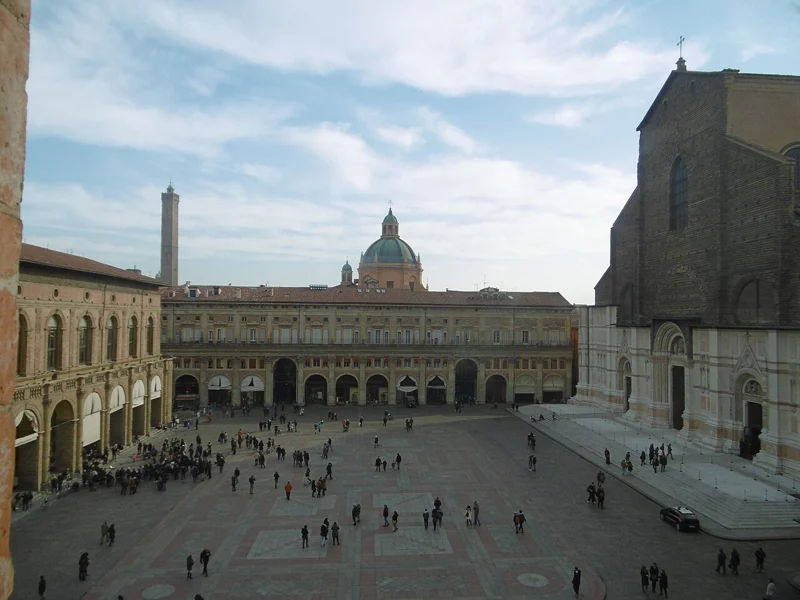
Begin in Piazza Maggiore with a look at the buildings on all sides before entering anything. The broad square gives you space to understand the relationship between the civic palaces and San Petronio. Walk around to the Neptune Fountain, then return along the eastern edge towards the Pavaglione portico. Following the covered walkway towards Piazza Galvani brings you to the Archiginnasio without sending you back through the busiest food-shopping lanes.
The Archiginnasio was an important university building; its heraldic decoration and Anatomical Theatre give this stop a specific purpose. Choose it if you want to see how study and civic identity shaped the city. Access to individual rooms depends on the visitor arrangements for your date. A courtyard or staircase visit should not be confused with a ticket that includes the theatre. Allow enough time for the interior you actually book, rather than treating every part of the building as one quick photo stop.
San Petronio is an active church. If a service occupies the space you hoped to visit, return later and continue the outdoor circuit. The square and adjacent porticoes still form a worthwhile first hour. With luggage, go to your accommodation first; carrying a case through these crowded passages makes even the short route awkward.
Lunch in the Quadrilatero, then Santo Stefano
From Piazza Galvani, turn towards the Quadrilatero's short streets, including Via Pescherie Vecchie and Via Drapperie. This is a good place to compare what is being sold before committing to a meal. A deli counter, a market stall and a seated restaurant provide different experiences. Check whether a displayed price is per portion, by weight or for a whole item, especially when buying cheese or cured meat to share.
Build lunch around one dish you want to try. Tagliatelle al ragù and tortellini are familiar local choices, but their presence on a menu does not make every kitchen equally good. Read the menu at the door, look at the portion format and choose a place that fits your appetite. A long pasta lunch followed by a large food tour can make the afternoon feel like a sequence of purchases. Leave one of those experiences for another day.
Continue towards Porta Ravegnana to see the Two Towers from the permitted pedestrian area, then head towards Piazza Santo Stefano. The church complex is a better place for a deliberate visit than for hurriedly counting buildings. Enter the parts open to visitors, pause in the square afterwards, and let this be the end of the principal sightseeing route. A table nearby gives you time to enjoy the setting after the busiest midday period.
Pick one view above the rooftops
Bologna's towers are landmarks even when you stay at street level. If a climb is important to you, compare the visitor options before the trip and reserve the one that is actually offered for your dates. The Clock Tower at Palazzo d'Accursio is a central alternative to the Asinelli experience. Do not build a two-day schedule around access to one particular tower: restoration, weather and timed admission can change the available choices.
An elevated view is most useful after the first walk. You will recognise the square, the church roofs and the streets you have just followed. Ask how many stairs the visit includes, whether there is a fixed departure time, and whether the ticket also covers an art collection. Those details determine whether the stop fills a short gap or needs a substantial part of the afternoon.
If stairs are uncomfortable, use that time for a longer look at the porticoes. Stand back where pedestrian space allows and compare their width, columns and ceiling heights. The covered walks are part of ordinary city life, with shop doors and residents' entrances along them. Keep the route clear while taking photographs. Our Venice itinerary offers another approach to reading an Italian city through its streets and public spaces.
Give San Luca a separate morning
The portico towards the Sanctuary of the Madonna di San Luca begins at Porta Saragozza and continues through the Meloncello arch towards the hill. Walking the entire approach is a substantial outing, not an extension of a quick city-centre stroll. The lower part introduces the continuous covered route; beyond Meloncello the climbing becomes the main feature. Decide whether you want the walk itself or mainly the sanctuary visit before choosing how to get there.
A practical shorter version is to reach the Meloncello area by the transport available on your date and walk uphill from there. A transport-assisted ascent with a walk down is another option, but descending still puts demands on knees and balance. The portico offers shelter; it does not remove steps, heat, wind or wet surfaces. Wear shoes suited to a sustained walk and carry water before you leave the centre.
Set aside the whole morning if you plan to walk in both directions with pauses. That is a generous editorial allowance, not a promised journey time. At the sanctuary, respect services and separate any optional viewpoint admission from access to the church. Return for lunch with the rest of the day uncommitted. If the hill does not suit your group, replace it with a shorter city portico walk rather than forcing everyone through the same route.
Choose the university quarter or a second food stop
After San Luca, the university quarter makes a different afternoon from the first day's monumental centre. Walk towards Via Zamboni and Piazza Verdi, choosing a museum or a short architectural stroll according to your remaining energy. You do not need to visit every university-related collection to appreciate the change in atmosphere. Look for a specific exhibition that interests you and check its address: the university is spread through the city, not contained inside one visitor building.
For a food-led afternoon, return towards Mercato delle Erbe and the surrounding streets instead. The market area works as a place to browse and choose dinner, but trading hours and restaurant service are different things. A late afternoon arrival may find a different mix of open businesses from a morning visit. If fresh-produce browsing is the priority, move that stop earlier and use the afternoon for the university district.
A cooking class can replace either option. Check its length, location, language and whether you prepare food yourself. Keep a booked class separate from a tight departure schedule. Travellers continuing north can compare the more museum-oriented pace of our Milan itinerary before deciding how many indoor visits to add to this trip.
Where to stay and how to arrive without a car
For this route, compare accommodation inside or near the historic centre with a base closer to Bologna Centrale. A central room shortens the return after dinner; a station-side location can be convenient for an early onward train. Look at the actual walking route, not only a circular distance on a booking map. A room described as near the centre may still involve a longer walk after the San Luca outing.
Bologna Centrale is a large station. Allow time to find your platform and distinguish the high-speed areas from the part of the station your train uses. Keep your arrival day free of tightly timed museum commitments. If you are flying, compare the airport connection for your arrival time and group size; the best option for one traveller with a small bag may be different for a family reaching the city late.
Once based in the centre, walking covers the first day's route. Use local transport when it meaningfully shortens the San Luca approach or the return to your accommodation. Save your room address and the station name offline. You can browse more trips built around this approach in our car-free travel guides.
Adapt the route to your budget and walking pace
The easiest saving is to choose paid interiors for their content. Piazza Maggiore, the portico walks and the route to Santo Stefano supply much of the city's character without a series of attraction tickets. Add the Anatomical Theatre or a tower because you want that experience, then compare any pass against those exact choices. A bundle containing several places you will not visit is unlikely to improve a short trip.
For a slower version, keep the first day between Piazza Maggiore and Santo Stefano, with one long seated break. On day two, choose transport assistance for San Luca or replace the hill with the university quarter. Travellers using a wheelchair should check each intended entrance and room with the attraction: a generally walkable centre does not mean every historic interior is step-free.
If you have only one full day, retain the central circuit and one meal, and leave San Luca for a return. With three days, give the extra time to a particular museum, a cooking class or a separate excursion. Adding another town to the second day would remove the unhurried hill-and-city combination that makes this two-day Bologna plan useful.
Frequently asked questions
Is two days enough for Bologna?
Two full days cover the historic centre, a chosen interior and a separate San Luca outing. Add another day if you want several museums, a cooking class or an excursion outside the city.
Can I visit Bologna without a car?
Yes. The central route is walkable, and local transport can shorten the San Luca approach. Choose accommodation with a practical route to Bologna Centrale if you are arriving by train.
Do I need to climb a tower?
No. The squares, porticoes and Santo Stefano route work without a climb. If you want a rooftop view, choose from the tower visits available for your travel dates and check the stair requirements.
How should I plan the walk to San Luca?
Treat it as a separate morning. Choose the full walk from Porta Saragozza, a shorter start near Meloncello, or transport assistance according to your walking ability and the weather.
Sources and checks
- Bologna Welcome — Two Towers visitor informationChecked: 23 October 2026
- Bologna Welcome — porticoes and San Luca routeChecked: 23 October 2026
- Bologna municipality — Archiginnasio porticoChecked: 23 October 2026
- Italia.it — Bologna in two daysChecked: 23 October 2026
Itineraries are editorial suggestions for independent visits. Check current prices, opening hours and trail conditions with official providers.