At a glance
Spend day one in Bergamo’s Città Alta around Piazza Vecchia, Piazza Duomo and the Venetian walls. Give day two to the Accademia Carrara and the lower city, with San Vigilio as an optional viewpoint. Bergamo has two different funicular routes: the city funicular reaches Città Alta, while the San Vigilio service continues from another station higher up.
Why Bergamo deserves two days
Bergamo's upper city is compact enough for a day trip, but staying longer gives you time for the art museum and the streets below the walls. It also changes how you experience Città Alta: you can return after a break, choose a proper evening meal and avoid fitting every view around a single return train. This itinerary gives the upper city a full first day and uses the second to explore the collection at Accademia Carrara.
Plan around elevation as well as distance. A short line between two sights can involve stairs or a slope, and the route back to your hotel may feel different after dinner. The table below uses generous suggested time blocks rather than a timed race. Use the city funicular or local transport where helpful, and choose San Vigilio only if you want another hill outing after the main upper-city walk.
| When | Focus | Allow |
|---|---|---|
| Day 1 morning | Città Alta, Piazza Vecchia and Piazza Duomo | 3–4 hours |
| Day 1 afternoon | Venetian walls and Porta San Giacomo | 2 hours |
| Day 2 morning | Accademia Carrara | 2–3 hours |
| Day 2 afternoon | Lower city or optional San Vigilio | 2–3 hours |
Follow the upper city in one direction
From the funicular’s Piazza Mercato delle Scarpe terminus, follow Via Gombito towards Piazza Vecchia, then pass into the neighbouring Piazza Duomo for the religious buildings. Afterwards, choose either the walls and Porta San Giacomo route or continue along Via Colleoni towards Colle Aperto. The latter is the useful direction for the separate San Vigilio funicular near Porta Sant’Alessandro. Allow roughly 20–30 minutes for an unhurried walk from the first funicular terminus through the main streets towards Colle Aperto, before admissions and stops. Accademia Carrara belongs to the lower-city portion of the trip; scheduling it on day two prevents repeated climbs between individual galleries and upper-city monuments.
Day one morning: arrive in Città Alta and find Piazza Vecchia
The city funicular links the lower city with Piazza Mercato delle Scarpe in Città Alta. It is a practical way to gain height before exploring on foot. Check current operating information and ticket validity, then leave room for waiting at busier times. Arriving at the upper station still leaves a walk through the historic streets to the main squares, so keep your first admission booking comfortably after the transfer.
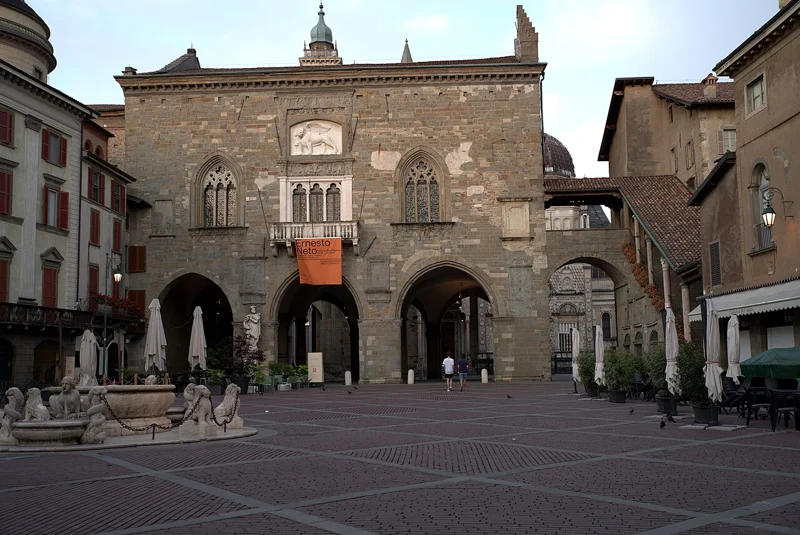
Make Piazza Vecchia the centre of your morning. The Contarini Fountain, Palazzo della Ragione, civic tower and surrounding buildings give the square a layered appearance that is easy to miss if you head straight through it. Sit for a few minutes or walk around its edges to see how the neighbouring spaces connect. This is a good point to orient yourself before choosing an interior visit.
The Campanone civic tower is a possible addition for visitors who want a higher view within the old town. Check the current visitor route and access arrangements before buying admission. You do not need both a tower ascent and every other viewpoint in this itinerary. If the square itself holds your attention, keep the morning at ground level and save the wider panorama for the walls later in the day.
Piazza Duomo: distinguish the neighbouring monuments
Piazza Duomo brings several important religious buildings close together, but they are separate visits. Bergamo Cathedral, the Basilica of Santa Maria Maggiore and the Colleoni Chapel should not be treated as three names for one attraction. Start by looking at how their façades meet around the square, then decide which interiors you want to see. Read the individual entrance information and respect worship or other restricted periods.
Santa Maria Maggiore and the Colleoni Chapel are particularly useful choices if historic decoration and architecture are priorities. Give yourself time inside rather than entering each building only long enough for a photograph. Admission, photography and access arrangements can differ, so follow the instructions at the actual entrance. A quiet, focused visit to one building may be more memorable than moving rapidly through several.
After this concentrated morning, take a lunch break before extending the walk. Città Alta has plenty to hold your attention, but sitting down changes the pace and makes the afternoon slopes easier. If your accommodation is in the upper city, a short return is also possible. Visitors coming from a lower-city base should think about the extra transfer before deciding to go back between every activity.
Day one afternoon: the Venetian walls and Porta San Giacomo
The Venetian walls help explain why the upper city feels distinct from the streets below. They form part of a UNESCO-listed fortification system and offer useful walking viewpoints. Choose a section of the public route rather than assuming that seeing the walls means completing their entire extent. The area around Porta San Giacomo is a good focus for understanding the relationship between the historic city and the lower town.
Allow time to look out across the landscape, then continue only as far as suits your group. A route with slopes, cobbles and changing levels is different from a flat urban promenade. Check the specific approach if you need step-free access, and avoid choosing an unfamiliar staircase as the return route simply because it appears shorter. If rain makes the surfaces uncomfortable, shorten the walk and spend longer inside a museum or café.
The upper city is worth revisiting after the main sightseeing stops. Choose a dinner location and take another short walk through the streets around Piazza Vecchia before eating. If you are staying below, confirm the evening transport options or your walking route back. Keeping that practical detail settled makes it easier to enjoy the evening rather than checking the clock throughout the meal.
Day two morning: Accademia Carrara
Accademia Carrara gives a second day in Bergamo a clear purpose. Its collection spans Italian art from the Gothic period to the nineteenth century, with artists including Mantegna, Bellini, Raphael and Botticelli, alongside important Lombard and Venetian painters such as Lorenzo Lotto and Giovanni Battista Moroni. Check the current display and exhibitions rather than assuming that every work listed in the collection is always on view.
For a first visit, allow roughly two to three hours. Pick a few artists or themes as a starting point and leave room for a painting that unexpectedly holds your attention. Portraits can be an approachable focus if you do not want to organise the visit around an art-history timeline. Read the labels closely enough to notice who is represented and how the painter has chosen to present them.
The museum's story is also tied to collecting and gifts: its holdings developed through patrons who made works available to the city. That context can make the visit more coherent than simply moving from one famous name to the next. If you enjoy this kind of collection, compare our Turin museum itinerary and the wider art and museums collection when choosing another Italian city break.
Lunch and the lower city
After the gallery visit, stay in the lower-city area for lunch. Casoncelli are a useful dish to look for: Bergamo’s filled pasta is commonly served with butter and sage, and fillings can combine meat with sweeter elements such as pear, raisins or amaretti. Recipes vary, so ask about ingredients rather than assuming a cheese-looking pasta is vegetarian. Polenta is another regional staple, served with different accompaniments; polenta taragna adds a richer cheese-and-butter element. Choose the portion and accompaniment that suit the rest of your walking day.
If you have an early departure, make this your final substantial activity. Leave enough time to collect bags and reach the station or airport connection from the place where you are actually staying. An afternoon described as free may still involve two transport stages when your hotel is in Città Alta. If your train is later, choose between returning to the upper city and continuing towards San Vigilio.
For a longer northern Italy trip, Milan in two days provides a larger-city contrast with its own museum and architecture priorities. Bergamo can be a separate overnight stop rather than a few hours inserted between Milan activities. Compare transport connections before fixing the order of the trip and avoid assuming that an airport carrying a regional city name is located in that city's centre.
San Vigilio: an optional second hill
San Vigilio is a separate outing above Città Alta. Its funicular departs from the area near Porta Sant'Alessandro, not from the same lower-city station used for the first ascent. You therefore need to move between the two routes if using both. Check the operator's map and current service details, particularly if your afternoon includes a timed return journey out of Bergamo.
Choose San Vigilio when the weather offers a worthwhile view and you have enough energy to enjoy the area after reaching the top. Include time for walking and pauses, not just the funicular ride. You may prefer to go on the first afternoon and move the walls walk to another part of the visit; the right order depends on visibility and your interests. There is no requirement to do every elevated viewpoint.
If the sky is overcast or you would rather avoid another transfer, return to a favourite upper-city square or extend the art visit. Visitors planning several Italian historic centres can compare Verona’s two-day route. The practical difference is useful: Bergamo asks you to plan explicitly around the hill, whereas your route in another city may be shaped more by a river or a large central monument.
Choosing accommodation and keeping the visit manageable
A room in Città Alta gives easy access to the upper-city evening, but check how you will get there with luggage and whether the building has stairs. A lower-city base can simplify rail arrivals and the Carrara visit, while adding a transfer to the historic centre. Choose the trade-off that suits your schedule rather than assuming that the highest or most central-looking address is always best.
For most visitors following this itinerary, walking and local transport are sufficient. If you arrive by car, check parking and access rules before entering historic streets. Decide where to leave the vehicle for the stay instead of planning to drive between the main attractions. Build some slack into your first morning so arrival delays do not affect a museum or guided-visit booking.
Budget for the Carrara and whichever historic interiors or viewpoints interest you, then let public squares and the walls walk fill the rest of the trip. Confirm opening days, ticket inclusions and the two funicular routes for your dates. With those details settled, Bergamo offers a satisfying balance of concentrated art viewing, historic architecture and time simply to look out from the hill.
Frequently asked questions
Is Bergamo worth staying overnight?
Yes, especially if you want the Accademia Carrara as well as Città Alta. An overnight stay also gives you time for an upper-city evening and a less rushed approach to the walls and religious buildings.
Are there two funiculars in Bergamo?
Yes. The city funicular connects the lower city with Piazza Mercato delle Scarpe in Città Alta. The San Vigilio funicular is a separate route starting near Porta Sant’Alessandro. Check the operator’s current map and services.
What should you see in Bergamo’s upper city?
Begin with Piazza Vecchia and the neighbouring Piazza Duomo, choosing among the cathedral, Santa Maria Maggiore and Colleoni Chapel. Add a section of the Venetian walls and Porta San Giacomo, with a tower or San Vigilio only if it suits your time.
Can you visit Bergamo without a car?
Yes. Walking and local transport work well for this route. The main consideration is elevation: use suitable transport between the lower and upper city, and check access routes if stairs or steep paths are difficult.
Sources and checks
- Visit Bergamo: upper townChecked: 23 October 2026
- Visit Bergamo: city funicularChecked: 23 October 2026
- Visit Bergamo: San Vigilio funicularChecked: 23 October 2026
- Accademia Carrara: collection and visitChecked: 23 October 2026
- Accademia Carrara: tickets and opening hoursChecked: 23 October 2026
- Visit Bergamo: casoncelli and polentaChecked: 23 October 2026
Itineraries are editorial suggestions for independent visits. Check current prices, opening hours and trail conditions with official providers.