At a glance
Use your first Verona day for the Arena area, the old-town squares and a walk across Ponte Pietra. Spend the second at Castelvecchio and San Zeno, or shorten that day with a single museum visit. Two full days leave room for the river and meals without treating every tower, church and literary attraction as compulsory. The central route works well on foot, with transport for the station connection if needed.
Divide Verona by neighbourhood, not by ticket count
Verona's compact centre can make a long attraction list look easy. The time-consuming part is entering each place, reading displays and waiting for booked slots. A better two-day plan groups nearby streets and makes one substantial visit the focus of each half-day. On the first day, follow the central squares towards the north of the river loop. On the second, give the western side of the centre and its art collections their own space.
The itinerary below uses flexible morning and afternoon blocks. They are suggested planning allowances rather than fixed walking times. Choose which interiors matter before buying a city card. Someone keen on painting and architecture may prefer Castelvecchio and a church visit; a visitor drawn by Shakespeare may choose Juliet's House instead. Both can enjoy the same outdoor route without paying for the same tickets.
If you are linking Italian cities by rail, compare this relaxed two-day stop with our Venice itinerary. Keep the transfer between them separate from any timed entry, particularly when travelling with luggage or changing trains.
| Time | Area | Priority |
|---|---|---|
| Day one morning | Piazza Bra to Piazza delle Erbe | Arena or one central visit |
| Day one afternoon | Piazza dei Signori to Ponte Pietra | Squares and river views |
| Day two morning | Castelvecchio and bridge | Art and architecture |
| Day two afternoon | San Zeno or a chosen central collection | One final substantial visit |
Start at Piazza Bra and the Arena
Begin in Piazza Bra, where the Arena gives the city an immediate Roman reference point. Walk around the permitted exterior route first so you can appreciate the scale of the building from the square. Daytime admission and an evening performance are different experiences. Buying one should not lead you to assume that you have access to the other.
If you want to go inside, check the Arena's visiting arrangements for your travel date and allow a proper visit before continuing into the old town. Stage preparation and events can influence how the monument is used. An outdoor look still fits the route when your preferred interior slot is unavailable. Avoid pinning the rest of the day to a precise exit time unless you have left a comfortable margin.
From Piazza Bra, continue along Via Mazzini towards the older squares. This is a shopping street as well as a connection, and busy periods can slow the walk. If you have just arrived at Porta Nuova station, leave your bags first and use the bus or walk that best suits your accommodation. The distance from the station is separate from the shorter sightseeing circuit inside the centre.
Read the old town through its squares
Piazza delle Erbe makes a natural pause after Via Mazzini. Look at the surrounding façades before moving on to Piazza dei Signori and the nearby Scaliger tombs. These spaces sit close together, but have different atmospheres: one is a busy market and meeting place, another feels more enclosed and formal. Let the walk reveal those differences instead of treating them as three points to tick off.
The Lamberti Tower is an optional way to see how the streets fit inside the Adige's curve. Before adding it, check the stair and lift arrangements and what your ticket covers. A lift-assisted visit is not necessarily a completely step-free experience. If one person wants to climb while another does not, agree on a meeting point and leave enough time for both to enjoy the square.
Choose lunch around this part of the centre or continue a little farther from the busiest junctions before sitting down. Read the menu rather than assuming the closest terrace is the right choice for your budget. You can use the middle of the day for a longer break because the afternoon route follows a clear line north towards Sant'Anastasia and Ponte Pietra.
Decide what a Juliet visit means to you
Juliet's House is a literary and cultural attraction connected with Verona's association with Romeo and Juliet. It is not evidence that Shakespeare's fictional characters lived there. If that association interests you, make a deliberate visit and enjoy how the city presents the story. If your main interests are Roman buildings and painting, you can leave it out without losing the structure of this itinerary.
Check the current entrance location, the available visit options and the reservation requirements before setting off. The courtyard and house can have different access arrangements. Do not assume that a courtyard is an unrestricted public shortcut or that a city card removes the need for a time slot. The municipal visitor information is the right place to resolve those details for your date.
Place the visit before or after the central-square walk according to the slot you obtain, rather than crossing the old town several times to preserve a rigid order. When queues build around narrow entrances, keep shop doors and pedestrian space clear. This is also a useful place to reduce the day if your group is tiring: a quiet meal or an earlier river walk may be more enjoyable than another wait.
Cross Ponte Pietra for a different view
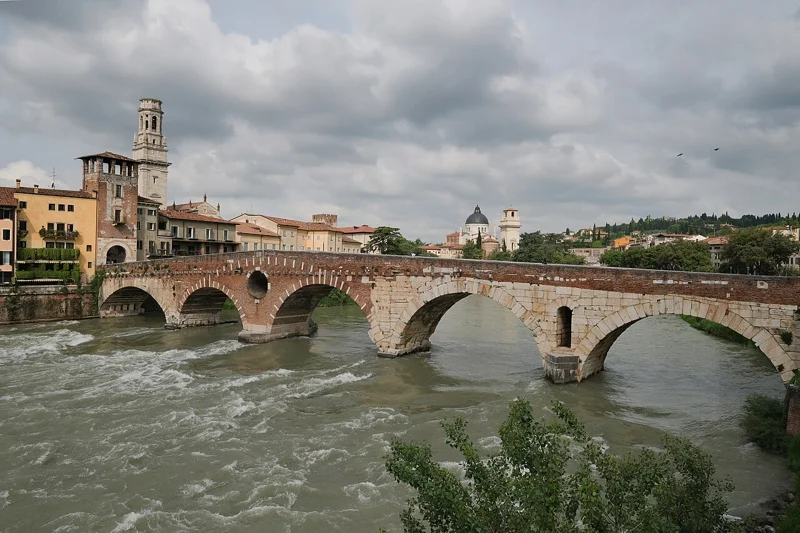
From the squares, continue towards Sant'Anastasia and then Ponte Pietra. The bridge changes the perspective: the river becomes the foreground and the old town turns into a skyline. Pause on the approach where there is room, then cross without blocking the pedestrian flow. The opposite bank provides a natural choice between staying near the water and climbing towards the Castel San Pietro viewpoint.
If you want the higher view, choose the steps or check the funicular's operation and admission. Treat it as a separate excursion within the afternoon, especially if anyone in the group walks slowly. The descent is part of the effort too. Staying at river level still gives you a satisfying end to the day and leaves more time for the Roman Theatre area if archaeology is your priority.
Return across the river for dinner rather than adding a distant neighbourhood at the last moment. A short visit often improves when the evening has a familiar route back to the room. For another Italian city where a river walk balances indoor sightseeing, our Florence itinerary separates gallery time from the streets around the Arno.
Give Castelvecchio and San Zeno the second day
Start the second morning at Castelvecchio. The castle and its bridge are striking from outside, but the museum deserves time if you choose to enter. Carlo Scarpa's architectural intervention makes the display itself part of the experience. Look at how objects, openings and views relate to one another rather than treating the collection as a corridor on the way to a photograph.
Allow a generous morning block for the museum and nearby riverbank, adjusting the duration to your interest in the art. Afterwards, head towards San Zeno along the western side of the centre. This makes a more coherent second-day route than returning immediately to the squares you explored yesterday. Stop for lunch before the church visit if its access schedule makes that sensible.
San Zeno is an active place of worship as well as an architectural destination. Check visitor entry separately from service times, and keep your clothing and behaviour appropriate to the setting. If you would rather stay with art museums, use the afternoon for another chosen collection in the centre. Our art and museum guides are intended for that kind of selective trip, with time to look rather than a race through every available admission.
Work out whether Verona Card helps
Make a list of the places you intend to enter, then compare their individual admissions with the current Verona Card options. Check the included urban transport, the validity period and any extras charged separately. The card's value depends on your actual route. A traveller planning the Arena, Castelvecchio and several churches has a different calculation from someone content with the squares and river walks.
Booking and admission are separate questions. A place can be included in a pass while still requiring a reservation or following its normal entry procedure. A pass also does not guarantee that every attraction is available throughout your stay. Review the official terms before choosing the first use, because activation timing can determine which visits fall within the validity window.
Leave optional extras out of your initial calculation. If the second day's weather is excellent and you choose a longer river walk, you should not feel obliged to enter another building simply to justify the card. For similar planning choices elsewhere in northern Italy, see the Milan guide, where the major reservations also shape the pace of a short visit.
Adapt the route for a shorter visit or limited walking
For one full day, keep Piazza Bra, the old-town squares and Ponte Pietra, adding one paid visit. Leave Castelvecchio and San Zeno for a return unless one of them is your principal interest; in that case, make it the focus and shorten the central circuit. With a third day, you can investigate a separate excursion without sacrificing either half of the city visit.
If steps are difficult, skip the viewpoint climb and ask each attraction about its accessible route. Historic paving, bridge approaches and internal museum circulation need more specific checks than a general claim that Verona is walkable. Plan your accommodation around the route you will actually take, particularly for late returns after a performance.
Before departure, leave time to collect luggage and reach Porta Nuova. A final coffee near your accommodation is easier to manage than one last tower visit with an uncertain queue. Keep the river walk flexible so it can absorb a slower lunch, a museum that captures your attention or a change in the weather. Those are normal parts of a good two-day trip, not reasons to rush through the remaining streets.
Frequently asked questions
Is Verona worth two full days?
Yes. Two days let you separate the Arena and central squares from Castelvecchio, San Zeno and the river, with time for selected interiors and meals.
Do I need to visit Juliet’s House?
Only if its literary and cultural connection interests you. The outdoor route and the city’s Roman and artistic attractions make a complete visit without it.
Does Verona Card remove all reservations?
No. Check each attraction’s admission and booking rules separately, as well as the pass validity and included transport. Some visits can require a time slot even with a card.
Can I enjoy the river views without climbing?
Yes. Ponte Pietra and the riverbanks provide views at street level. The higher Castel San Pietro viewpoint is an optional addition with its own access arrangements.
Sources and checks
- Verona municipality — two-day walking routeChecked: 23 October 2026
- Visit Verona — Verona Card terms and inclusionsChecked: 23 October 2026
- Verona municipality — Juliet visitor accessChecked: 23 October 2026
Itineraries are editorial suggestions for independent visits. Check current prices, opening hours and trail conditions with official providers.