At a glance
Spend day one walking from Hàng Gai through the Old Quarter to Hoàn Kiếm Lake. On day two, visit the Temple of Literature and choose Hỏa Lò or a lighter French Quarter afternoon. On day three, follow Thanh Niên between West Lake and Trúc Bạch, stopping at Trấn Quốc before lunch on Ngũ Xã. These are three full city days; arrival transfers and an excursion to another province need additional time.
How this three-day Hanoi route works
This route begins and ends its busiest day near Hoàn Kiếm, gives educational heritage its own morning, and finishes with a small lakeside area rather than a circuit of the enormous West Lake. It suits a first visit with an interest in street life, architecture and food. It is an editorial route researched from tourism and heritage sources, without a claim that our team personally walked it. Walking allowances below assume an independently mobile adult, ordinary stops and no major disruption; they are suggestions rather than measured journey times.
Choose accommodation by its exact street. The southern Old Quarter makes the first day convenient; a property facing the Tạ Hiện entertainment area may have a very different evening soundscape from one nearer the cathedral. Ask about room location and vehicle access if you have heavy luggage. A lake-view photograph does not establish a quiet bedroom. This plan starts after arrival and check-in: an afternoon flight gives you an orientation evening, not three full sightseeing days.
| Day | Route | Planning allowance | Main choice |
|---|---|---|---|
| 1 | Hàng Gai → guild streets → Mã Mây → Hoàn Kiếm → cathedral | Full day; 2–3 hours for the street block with pauses | Ngọc Sơn interior or water puppets |
| 2 | Temple of Literature → Hỏa Lò or French Quarter | 90–120 minutes for the temple; separate afternoon | Prison history or an outdoor architectural walk |
| 3 | Thanh Niên → Trấn Quốc → Trúc Bạch → Ngũ Xã | Half-day lakeside block plus a flexible finish | Short lake visit; no complete West Lake circuit |
Day one morning: an Old Quarter route you can follow
Start on Hàng Gai just north of the lake. Use Hàng Đào to move north, turn towards the decoration shops of Hàng Mã, and continue through Lãn Ông before working east towards Hàng Bạc and Mã Mây. Save those six names on your map before leaving. They give you a sequence and stopping points, while leaving you free to choose the exact connecting public streets according to traffic and pavements. You can shorten the route after Lãn Ông by returning towards the lake instead of continuing east.
Vietnam Tourism identifies Hàng Gai with fabrics, Hàng Mã with festival and religious goods, Lãn Ông with traditional medicines, and Hàng Bạc with jewellery. The street names are a useful way to notice different trades, although they do not mean every shop still follows its historical speciality. Look at narrow building fronts and the way commerce shares the street. Avoid turning the walk into a hunt for a prescribed photograph: working entrances and private upper floors are not visitor areas.
Mã Mây House gives the eastern part of the walk a possible interior stop. Choose it if domestic architecture interests you, subject to its actual admission arrangements; otherwise continue along Mã Mây and towards the lake. Allow two to three hours for the whole street block including a drink and browsing. That allowance describes how to pace this route, not a guaranteed walking duration. Keep Đồng Xuân Market as an optional substitution for the eastern section rather than extending the morning indefinitely.
Lunch: choose a dish and understand what you are ordering
For a first Hanoi lunch, bún chả offers grilled pork with noodles, herbs and a dipping broth; phở is the soup alternative. The tourism board identifies Hàng Quạt as one place to look for bún chả. Choose a currently operating business with a readable menu and a seat that suits you, rather than treating an old listing as a restaurant reservation. Ask which extras are charged separately. If pork is unsuitable, saying only that you want noodles will not reliably communicate your needs.
Egg coffee is another Hanoi speciality, but its name matters for anyone avoiding eggs. Decide whether you want that drink or ordinary Vietnamese coffee, and ask about milk and sweetening. A food-led morning could replace the heritage-house interior with a longer lunch and coffee; it need not add another distant restaurant. Keep your selection within the Old Quarter so the afternoon starts at the lake, with time to sit before more walking. The Bangkok itinerary gives a separate route for a different Southeast Asian food and river setting.
Day one afternoon: Hoàn Kiếm, Ngọc Sơn and the cathedral
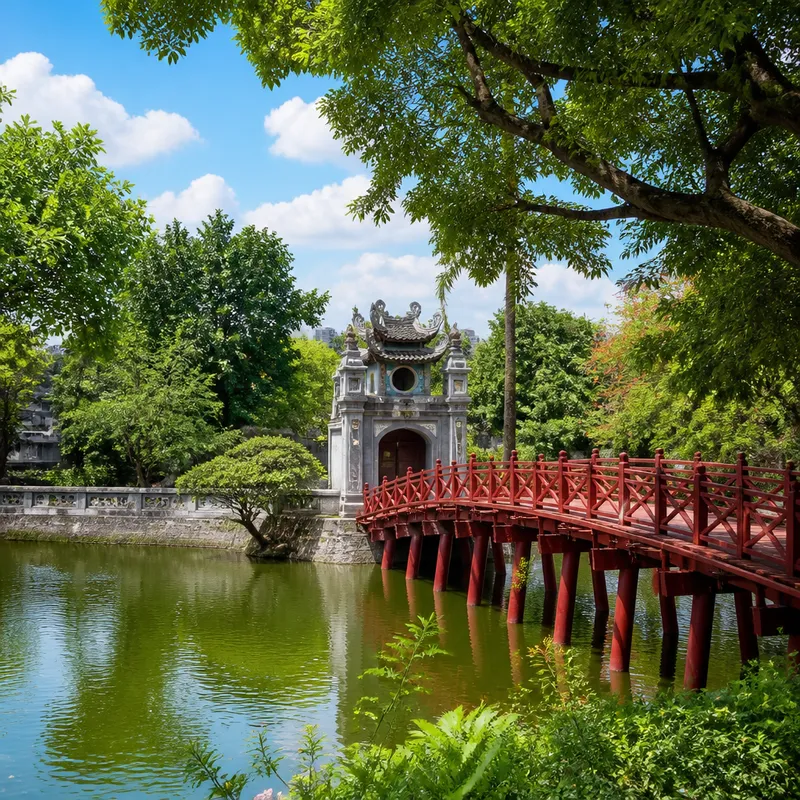
From the eastern Old Quarter, come down to Đinh Tiên Hoàng on the lake’s east side. Ngọc Sơn Temple and the red Húc Bridge are on the northern part of that shore. Decide here whether to buy admission to the temple or keep the afternoon as a public waterfront walk. The lake path and the ticketed religious site are separate experiences. We have not independently reconciled the temple’s current tariff, so this guide does not repeat an older tourism-page price as a confirmed 2026 charge.
Continue south along the lake, then use the western side for the return towards the cathedral area. A full public lakeside circuit and a temple visit need more time than a quick photograph at the bridge. For a shorter afternoon, finish at the southern end and take a seated break before heading along the central streets towards Nhà Thờ and St Joseph’s Cathedral. The exterior square is your endpoint; entering during worship is a separate decision governed by the church’s visitor arrangements.
If you want an evening water-puppet performance, look for the Thăng Long theatre at the northeast lake corner and choose an actual available show. It is a convenient addition to this day because it brings you back to a known area. Do not copy a historical performance timetable into your booking plan. Compare the current show and seat price, then make dinner fit that time. This itinerary deliberately leaves railway-side cafés out of its recommended route: an attractive old photograph does not establish present permission to enter railway space.
Day two morning: the Temple of Literature has a clear purpose
Travel west to Văn Miếu–Quốc Tử Giám, the Temple of Literature. The official tourism attraction page places it at 58 Quốc Tử Giám. Give the driver or route planner that place name and the visitor entrance, rather than a generic temple marker. A road transfer is the useful default from the Old Quarter; walking across the city adds a separate urban journey before the site itself. Save enough energy for the courtyards, which are the reason for making this trip.
The temple was founded in 1070; the academy followed in 1076. Its significance is educational as well as architectural. Use the successive courtyards, pavilion and scholar records to understand how learning was celebrated, rather than treating the site as another decorative temple. A suggested 90–120 minutes gives room for interpretation and pauses. It is our planning allowance, not an operator promise. Visitors interested in inscriptions may need longer, while someone wanting only an overview can choose a shorter visit.
There is a useful source limitation here: the tourism board’s general attraction page contains an older admission figure, while other public listings show a different tariff. We retain the primary page for location and historical context, and do not present that unresolved figure as a current price. Check the temple’s own sales information for the date you visit. Keep your next booking flexible enough to read the displays; a 30-minute photograph stop would miss much of the reason to come.
Day two afternoon: prison history or a lighter French Quarter walk
Choose Hỏa Lò if you want to continue with modern history. The relic operator identifies the museum at 1 Hỏa Lò Street. It is a different subject from the temple: detention and political history rather than the institutions of learning. Travel to the named entrance and allow a separate visit, instead of treating it as a brief stop on the way to somewhere else. A suggested 90 minutes is a starting allowance; exhibition reading and the weight of the material may justify longer.
For a lighter afternoon, skip that interior and return towards the southern lake and French Quarter. Use Tràng Tiền as your spine, continue to the Opera House exterior, and return by the surrounding public streets. You gain a contrast with the Old Quarter’s commercial lanes without trying to enter a theatre outside a booked performance. These are alternatives, not a requirement to complete both. Lunch after the temple, one chosen afternoon and a central dinner already make a substantial day.
Day three: exactly which part of West Lake to visit
Use Thanh Niên as your starting street. Vietnam Tourism describes it as the divider between expansive West Lake and smaller Trúc Bạch. Set Trấn Quốc Pagoda as the first named stop, reached from this road, then return to the public lakeside pavement. Your walk covers this southern lake setting; it does not require travelling around the entire West Lake shoreline or reaching every café in Tây Hồ. That distinction keeps a final city day manageable.
Treat Trấn Quốc as an active religious place. Wear suitable clothing, keep voices low and follow the actual entry and photography signs. If visitor access is unavailable, use the public lake view and continue the route; an exterior view is not a claim to have visited all of the complex. Cross only at a suitable crossing and move towards Trúc Bạch for the second part of the block. The two waters sit close together here but the road remains a real traffic boundary.
Finish with Ngũ Xã as a lunch destination near Trúc Bạch. Vietnam Tourism identifies the street with phở cuốn, rice-noodle rolls, giving this endpoint a purpose beyond finding an unnamed café. Check ingredients and the operating menu at your chosen restaurant. Allow roughly half a day for the pagoda, short waterfront walks, a drink and lunch, including your transfer to the area. The Singapore itinerary offers another urban garden-and-heritage trip; it does not replace travel time between countries.
What to shorten, what to book and how to finish
In heavy rain, retain the Temple of Literature or chosen museum as the main visit, and cut the exposed lake block rather than crossing Hanoi repeatedly for substitute attractions. For limited walking tolerance, shorten day one after Hàng Bạc and divide day three into a pagoda stop and a seated lunch reached by transport. Narrow pavements and crossings can make a map distance misleading. This is a route adaptation, not an audited wheelchair itinerary; ask each operator about the access you need.
Separate spending into accommodation, the two selected heritage entries, local transfers and meals. Public street walks and lake paths do not require a multi-attraction pass, while a show, guided food tour or additional museum is an extra purchase. We have not published a fictitious all-in daily budget without current quotes. Compare the actual options you intend to use. A trip to Ninh Bình or Hạ Long replaces a Hanoi day or needs another day; hotel pickup does not erase the long excursion.
If departure falls on day three, decide before breakfast whether the half-day lake block fits luggage collection and your actual onward journey. Keep the final optional coffee near the pickup location. Otherwise return to a favourite street from day one and give the last evening to a meal instead of another checklist. Our city break guides collect distinct routes for longer travel planning. Before leaving, save the named stops, your chosen entrance confirmations and the complete airport or station connection.
Frequently asked questions
Is three days enough for Hanoi?
Three full city days cover this Old Quarter and Hoàn Kiếm route, the Temple of Literature with one afternoon choice, and a short West Lake–Trúc Bạch block. Arrival time and an excursion outside Hanoi need extra allowance.
Which Old Quarter streets should I start with?
Use Hàng Gai, Hàng Đào, Hàng Mã, Lãn Ông, Hàng Bạc and Mã Mây as a connected sequence, shortening it if the heat or pavement conditions make walking uncomfortable.
Where does the West Lake route start and finish?
Start on Thanh Niên at the Trấn Quốc stop, explore the public southern lake setting, then move towards Trúc Bạch and Ngũ Xã for lunch. It is a short selected block, not a complete West Lake circuit.
Should I copy the admission prices on the general tourism page?
Some general attraction listings contain tariffs that conflict with other public information. This route uses those pages for verified location and context, but leaves unresolved prices out; use the specific operator’s current sales information.
Sources and checks
- Vietnam Tourism: Old Quarter trades and walking contextChecked: 8 October 2026
- Vietnam Tourism: weekend route and Ngũ Xã foodChecked: 8 October 2026
- Vietnam Tourism: attractions, temple history and addresses; tariffs not adoptedChecked: 8 October 2026
- Vietnam Tourism: Thanh Niên between West Lake and Trúc BạchChecked: 8 October 2026
- Hỏa Lò relic operator: historical site and 1 Hỏa Lò addressChecked: 8 October 2026
- Hanoi municipal planning: Trấn Quốc and Thanh Niên locationChecked: 8 October 2026
Itineraries are editorial suggestions for independent visits. Check current prices, opening hours and trail conditions with official providers.